
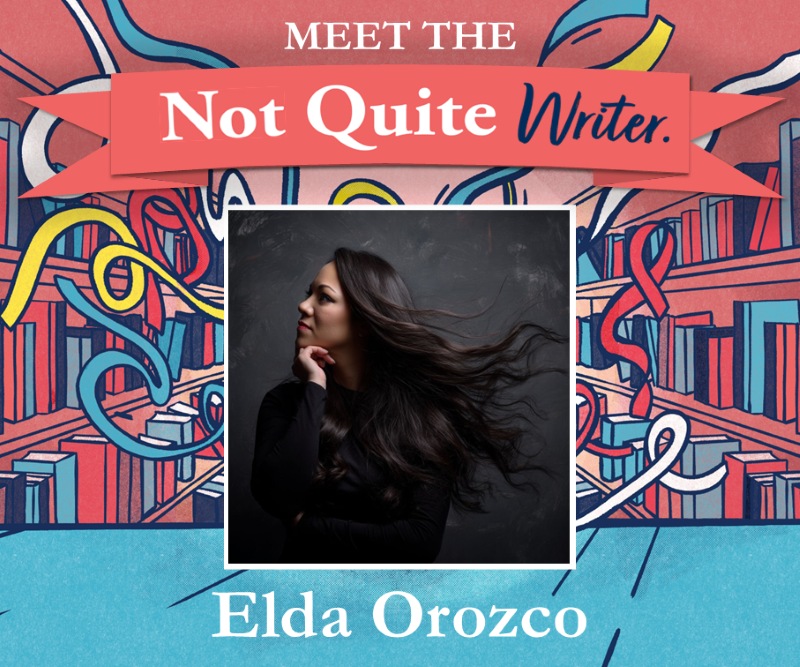
In this article, we interview Elda Orozco, WINNER of the July 2025 Not Quite Write Prize for Flash Fiction with her story, Fold. Burn. Inhale.
Hi Elda, can you tell us a little bit about yourself and your writing backstory?
I was born in Mexico and relocated to Switzerland almost thirteen years ago for work; now it’s my home. I also lived in Spain and in Australia. Australia was the first country I lived in outside Mexico, which makes winning the Not Quite Write competition even more meaningful.
I’m a deeply curious person, and that curiosity has charted my path. I’ve always looked for ways to express myself: learning to bake, to decorate cakes, to draw, to practice calligraphy. But writing found me in a different way. In 2020, I wrote a novel that felt almost dictated to me. After a first edit, it went into a drawer, but I serve a tenacious muse, and after some inescapable nagging, I restarted writing in November 2023. I joined a flash fiction course that challenge me to write a story every day for 30 days.
I’d never heard of flash fiction, but it seemed like a perfect engine for momentum. One story a day makes it easier to feel a sense of completion, to end one and move on to the next. I also didn’t know about writing prompts. For a new writer, they are a gift. They let you try on different selves, different voices, before you discover your own.
By the way, my magnificent muse snuck into the April 2025 NQW story.
You WON the July 2025 Not Quite Write Prize. What did/will you spend your prize money on?
I haven’t spent it. This was my first big win, so I opened a separate savings account where I keep it. I like to see it there. It’s not just money; it’s a tangible symbol of possibility.
You’re a Latina, living in Switzerland, writing in English. How does this cross-cultural experience influence your writing?
Living between Mexico and Switzerland for so long has created an integrated context within me. It’s not that I have a Swiss self and a Mexican self. It’s that my way of seeing the world, my instincts, is a unique synthesis of both. This becomes my storytelling lens.
The challenge as a storyteller is that this integrated perspective isn’t easily legible to an audience living primarily within one context. The conflicts my characters face, their silences, their decisions, are often born from this internal negotiation of values that the reader can’t see. For example, a character’s profound sense of obligation might read as simple stubbornness, unless I can somehow convey the invisible weight of two different cultural codes of honor pulling them in the same direction.
Resonance isn’t universal. While publications and contests are technically open to all, the truth is that judges, like all readers, select what resonates with them personally. Resonance requires some shared context or experience, which can be a complex starting point for someone writing from a Latin-European perspective about themes like Mayan cosmovision. So, writing becomes a compromise: a balance between the stories I want to tell and those that will resonate with an English-speaking audience.
In flash fiction, it’s even more acute. With less than 1000 words, there’s no space to build extensive cultural scaffolding. I must choose a spark from my world that can catch fire quickly in a reader’s imagination or lead with a universal human emotion—grief, a mother’s fear, or longing.
Your story had a strong supernatural element. Is this a common theme for you?
I’m drawn to what the literary world calls ‘magical realism.’ I find the term itself revealing. In Mexican culture, the magical isn’t an intrusion on reality. It’s a layer of it. The nagual, the spirit in the wind, the memory in the stone, these aren’t ‘magic’ in a fantasy sense. They are part of a coherent, lived reality. So, in my stories, I’m not adding fantasy elements to make a realistic story more interesting. I’m depicting, as accurately as I can, a worldview where the material and spiritual are interwoven.
Your story included a burning paper crane, which was one of the more common takes on the prompts for the July round. What do you think made your story stand out above others exploring a similar idea?
I think the key ingredient was the anti-prompt: breaking the rule ‘use active voice.’ Active voice is the most expected rule in writing. Any grammar tool will tell you to change every sentence to it. But passive voice was the perfect vehicle for embodying Richard’s powerlessness. The crane ‘had been folded,’ Nina ‘had grown weak,’ the ash ‘curled upward.’ That voice created a suffocating atmosphere where the magic and the grief felt inevitable. The passive voice became the story’s emotional engine. Grief steals your verbs. It makes you a patient instead of an agent. The reader isn’t watching Richard do things so much as feeling the world happen around and within him. I think that passivity made the haunting feel real.
I’m going to miss the anti-prompt, but I’ll keep its brilliance with me. We live in a world that promotes standardization, yet rethinking the rules can yield unexpected perspectives. This is particularly true for flash fiction that already promotes unconventional storytelling structures.
What do you enjoy about the 500-word format?
On a technical level, 500 words in 60 hours is a fascinating discipline. It allows for a sliver of world-building, a heartbeat of a story, and a hint of research. My personal sweet spot is longer, around 800 to 1200 words. That space gives me room to breathe, to develop what I think of as the ’carnality’ of a story.
Carnality is key for me—the tactile, sensual quality of a world. The weight of a clay cup, the scent of copal resin hitting hot coal, the specific fatigue in a character’s shoulders. This isn’t just decoration; it’s how emotion and culture are felt in the body.
Can you share any words of wisdom with our Not Quite Write Prize hopefuls?
I’m very new to writing, so I hesitate to give advice. But I’ll share my experience: I was genuinely surprised to win. I’d seen the names of previous winners and hadn’t seen any Latin female names. I’d accepted that winning, or passing the first filter, was a long shot. The original idea of my story was more mundane. I remember thinking that, at most, one person would read it. So, I chose not to censor myself.
I was proven wrong. I can say from experience: Not Quite Write is the real deal in terms of being open to new voices. My wisdom is simply this: if you feel that quiet doubt, use it. Let it be the reason you stop holding back the unique, specific, ‘weird’ heart of your story. Send that version.
About Elda
Elda Orozco is a writer of fiction and creative non-fiction who maps the silent, contradictory territories of the human heart. Her work lives in the liminal space—between the magical and the real, the said and the unsaid, a shared grief and a private hunger. Whether unravelling a true story or weaving a speculative tale, she seeks the raw, enduring sparks that flicker in the shadows, asking what we hide from others and, more importantly, from ourselves.
You can connect with Elda at:
Bluesky: @eldaorozco.bsky.social
Instagram: @elda_orozco_writer
Medium: @elda.orozco