
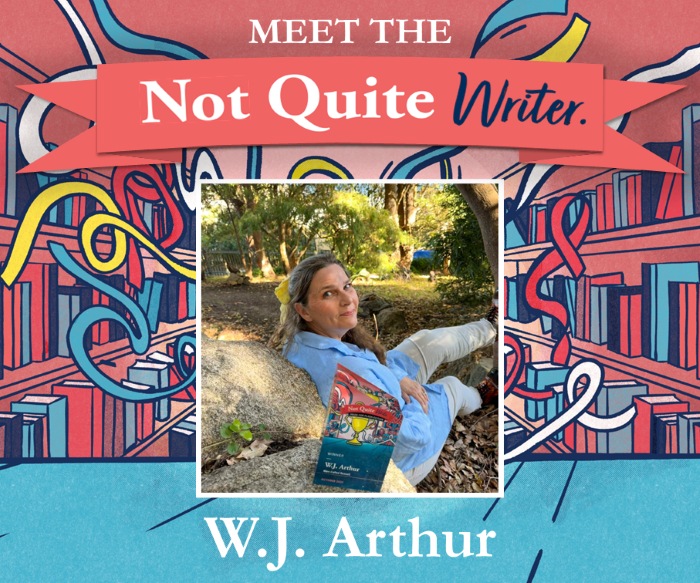
In this article, we interview W.J. Arthur, WINNER of the October 2025 Not Quite Write Prize for Flash Fiction with her story, Men Called Russell.
Hi W.J., can you tell us a little bit about yourself and your writing backstory?
In Scotland in the 1950’s a fortune teller told my Mum that one of her children would be a writer, and I came along full of stories twenty years later.
During the pandemic, my daughter challenged me to write a short story a day. I thought the task was impossible, but five years later I am continuing to fill at least a page a day. I use a Japanese diary called Hobonichi (the cousin A5 size).
As I work towards my goal of widespread publication, I have completed a Masters in Creative Writing and am determined to both learn and recover from the innumerable rejections as well as the delightful acceptances.
I have written two young adult fantasy novels about selkies set on a fictional Scottish island and hope to bring the Tramrocky world to a wider audience. The first novel, Tramrocky has been published on Amazon.
You WON the October 2025 Not Quite Write Prize. What did/will you spend your prize money on?
I am so grateful for such a generous prize! Thank you so much J It allows for so many options and will be carefully spent.
I have just moved to country Western Australia – so I think a light bar or spotlights on my little Honda Jazz for safer nighttime driving. The kangaroos here are huge. Following this practical note, getting the roof fixed to stop the rain dripping on my desk or to change the predominantly orange kitchen would be nice. Or I could be completely indulgent and buy a pair of dark green Dr Martens and a plane ticket to go the Glasgow Commonwealth Games later this year.
Your story was one of the darkest stories we’ve received, with many listeners reporting feeling deeply unsettled after listening to it on the podcast. What inspired you to go so dark?
I am so very sorry to unsettle the listeners!
I was under a lot of pressure that weekend. My Masters of Research 20,000 word thesis was due the following Friday. And we were in the middle of moving house – 420 kilometres away. The house was empty of furniture and we were sleeping on the floor, without a fridge, table or anything to sit on. I almost didn’t enter a story at all, because I thought I just wouldn’t be able to write.
I sat down cross legged, with the prompts, and just let the story come.
Stephen King said ‘A good novelist realises he is a secretary, not God.’
This is very much true for the stories I write. I may have some vague ideas about how the story is going to pan out, but it takes on a will of its own. I had thought that Russell was going to save Dolores, but as I wrote, he jumped his traces and refused.
A psychologist may suggest, on a deeper level, that the more disturbing elements of abuse and the bystander effect may come from people and events in my past. I think that all writers plumb the depths of their experiences to create an authenticity of feeling even if the story itself is not similar.
Some writers think there’s a bias towards darker stories over lighter stories in the competition setting. Do you believe there’s any truth to that idea?
I am probably not really answering the question, but I don’t write for the judges or for what I think they may prefer. I write the story that comes once I have looked at the prompts. I then double and triple check that I have covered all three prompts and submit.
I hope that results in an honest connection with the reader. I think allowing the story that wants to be created is as important as entering the competition.
If I was to think of what the judges may be looking for, I think it is a story that moves them, whether it is dark or light, something that makes them feel connected to the emotions of the story.
Your previous story, Ride It to Heaven, made the October 2024 Not Quite Write Prize shortlist. Both stories carry themes of coming of age entwined with life and death. Is this a coincidence, or are these themes you explore often in your writing?
When I was fifteen, we lost three members of my family in six months. My Gran Arthur, my Dad, Alex and my Uncle Roy.
When my Gran died, I found poems about loss and gave them to my Dad to read, never imagining that I would lose him just months later. After my Dad died, in my extreme grief, I found the book A String in the Harp by Nancy Bond. And suddenly, I wasn’t quite as alone and unsupported in my grief as I had thought. I went to Borth in North Wales, to connect with the characters in the book. Walking along the cold December beach, looking for the Low Hundred, I felt some comfort and I will be forever grateful for Nancy Bond for bringing that to me.
Being upended in the security of life is something that people experience. I guess, that in some of my writing, I would like to think that someone can feel, ‘Hey, this writer gets it too, she knows this pain as well, and she understands.’ Most of all, I would like for someone to feel a little less alone, and a little more part of humanity.
You’ve also written a novel, Tramrocky. Tell us about that.
As a first time author, I was naïve. I had the vastly mistaken belief that I only had to write a book and someone would be thrilled to publish it. Not quite an accurate reality, so I self- published Tramrocky on Amazon. It is a good story, one that deserves a chance because it isn’t just another rehash of very similar ideas.
Amanda and Ed may just be right about my penchant for writing coming of age stories, as Tramrocky is also about the difficulties of the liminal transition between youth and adulthood. Tramrocky has just the right mix of mythical beings that are needed to show what reality is. It is for young adults and isn’t dark or unsettling, but offers hope, inspiration and encouragement.
Can you share any words of wisdom with our Not Quite Write Prize hopefuls?
To all the entrants, firstly best of luck! Enjoy!
Forget that it is a competition. The prize is not the main aim (even though winning it is a wonderful surprise and bonus).
You are trying to craft the best story you can within the constraints you have been given. Let your vision go blurry, and catch the whispering wisps of ideas that are on the edge of your thoughts. Start with just once sentence, and then let the words flow from there. Hold the prompts lightly and don’t try to force the story into a mould that it doesn’t want to take.
Start thinking on the Friday, try to write the first draft on the Saturday and keep Sunday for the final editing. It is good if you can write the first draft and edit on different days. My weakest skill is editing, and I find the time distance helps to pick up more mistakes (but not all!).
About W.J.
W.J. Is a Pushcart Prize nominated author based between Albany, Western Australia and Rothesay on Scottish Isle of Bute. In Rothesay, from her third floor flat, she watches the herring gull chicks on the opposite roof, convinced that if she is watching them, they won’t fall.
Some of her published works include Let Me Weep (Swamp Magazine), The Well of the Heart (ELA Literary Magazine), Hidden in Plain Sound (in Our Selves by Night Parrot Press). In the 2024 Love to Read Local flash fiction competition, she was the winner of the people’s choice award with Spin Cycle.
In the prestigious Not Quite Write Prize for Flash Fiction, W.J. was shortlisted in October 2024 with Ride it to Heaven, long listed in April 2025 with The Ambiguity of Identity: Just Who Are You Carla Jane? And won the top prize in October 2025 with Men Like Russell.
W.J. Has her fingers crossed that she will get a publishing contract for a novel in the not very distant future, she just needs to get someone’s attention for a moment, and get a lot better at pitching.
You can connect with W.J. at:
Instagram: https://www.instagram.com/w.j.arthur_writer
Amazon: https://bit.ly/4pTmJxp